

Table of contents
Let's unravel the mystery: does the "female prostate" really exist? Role: what does the "prostate" do in women? Everything you need to know about the male prostate Explo by ONY: the art of prostatic stimulation Myths and realities about para-urethral gland disorders In summary: the female prostate doesn't exist, but…
The term "prostate" immediately calls to mind male anatomy. Yet the question persists: is the female prostate a myth or a biological reality? At ONY, French specialist in intimate accessories for men, we prefer to demystify these grey areas to offer you clear, precise and taboo-free information.
Key takeaways from the article
This article was produced by ONY, the first French brand specialising in intimate accessories for men.
Women do not have a prostate in the strict medical sense, but they do have Skene's glands (or para-urethral glands) which constitute the functional equivalent of the male prostate.
These glands produce PSA and an alkaline fluid during sexual arousal, contributing to female ejaculation in very small quantities (less than 5 ml).
The location of these glands in the anterior vaginal wall explains why G-spot stimulation can activate these erogenous tissues.
Why trust ONY?
French brand specialising in male pleasure
Premium intimate accessories designed for exceptional sensations
97% of satisfied customers, a testament to quality and performance
Unique "30-day satisfaction or money-back guarantee" in this sector
Let's unravel the mystery: does the "female prostate" really exist?
On its blog, ONY addresses all anatomical subjects directly, and this one is no exception. In the strict medical sense, no, the prostate is part of the male reproductive system. It is an exocrine gland exclusive to men.
Embryology tells us, however, that the tissues forming the prostate in the male foetus are also present in the female foetus. They simply develop differently under hormonal influence.

Women don't have a prostate but do have Skene's glands
While women do not have a prostate as such, they do have a prostatic remnant that serves much the same function. This homologous tissue is known as the Skene's glands (or para-urethral glands). Located on either side of the distal urethra, they share striking histological characteristics with the male prostate:
Biological markers: they produce PSA (Prostate-Specific Antigen).
Structure: they have ducts that open near the urinary orifice.
Although microscopic, these glands form a functional erogenous zone often associated with the G-spot.
Discover
ONY EXPLO
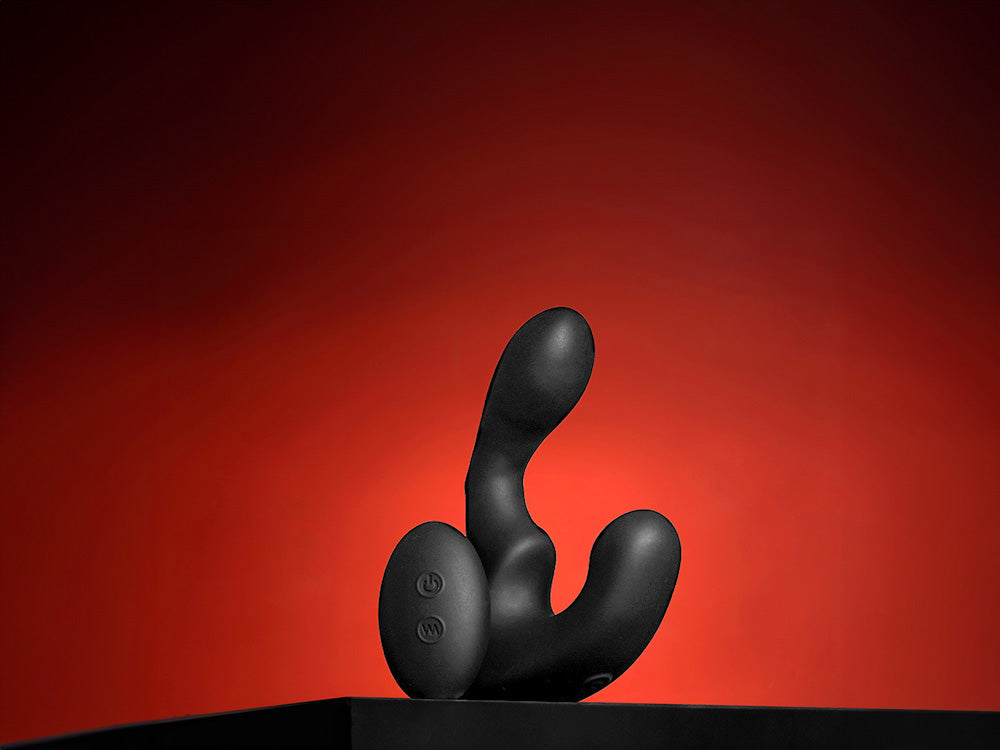
The prostate stimulator Explo targets your P-spot with precision, to trigger a deeper, more intense orgasm.
Role: what does the "prostate" do in women?
Research confirms that these glands play an active role during sexual arousal. Once stimulated, they produce an alkaline fluid whose composition is close to male prostatic fluid (PSA, enzymes).
In the majority of women, the Skene's glands are underdeveloped, which makes "female ejaculation" barely perceptible, as the fluid is produced in very small quantities. In other women, this phenomenon may be more noticeable. However, this "ejaculation" should not be confused with the phenomenon of female squirting (or squirting).
Feature |
Female ejaculation (Skene's) |
Female squirting |
Origin |
Para-urethral glands |
Bladder (diluted urine) |
Volume |
Very low (< 5 ml) |
Significant (> 50 ml) |
Appearance |
Thick, milky |
Clear, watery, transparent |
Composition |
PSA, enzymes, fructose |
Urea, creatinine, water |
Sensation |
Similar to a prostatic orgasm |
Reflex bladder expulsion |
Everything you need to know about the male prostate
To fully grasp the specificity of female anatomy, a detour through male standards is necessary. The prostate in men is a chestnut-sized gland nestled beneath the bladder. Its main function? To secrete part of the seminal fluid (20 to 30%) to nourish sperm. Sensitive to testosterone, this organ is prone to common pathologies with age (hypertrophy, cancer). This is precisely what makes the term "prostate" somewhat anxiety-inducing when applied by analogy to women.
Where are these little-known glands hidden?
Where the male prostate is compact, its female equivalent is diffuse. The Skene's glands are located in the anterior vaginal wall, embedded in connective tissue along the urethra. This positioning explains why stimulating the vaginal wall (the famous "G-spot") can activate these tissues. Unlike in men, this glandular tissue remains intertwined with muscles and mucous membranes, invisible to the naked eye except in cases of inflammation or a cyst. 🔍
Explo by ONY: the art of prostatic stimulation
Explo by ONY is the prostate massager designed for those who want to explore new sensations with elegance and precision. Created by the French brand ONY, it combines ergonomic design, ultra-soft silicone and a carefully studied curve to perfectly target the P-spot. Its intuitive shape makes it easy to handle and ensures optimal comfort, whether you are a beginner or experienced. Discreet, powerful and refined, Explo by ONY transforms every discovery into an intense, deep and controlled experience… Ready for an unforgettable experience?
Myths and realities about para-urethral gland disorders
The existence of this prostatic tissue in women opens the possibility of developing pathologies similar to those seen in men, even if their frequency remains radically different. Separating myths from medical realities helps to see things more clearly.
"Prostate cancer" in women: separating fact from fiction
Can a woman develop prostate cancer? Technically, adenocarcinoma of the Skene's glands does exist, but it remains extremely rare. These tumours express the same markers as male prostate cancer:
They respond positively to PSA.
They are treated using similar approaches (surgery, radiotherapy).
The risk remains minimal, but it proves the homology of the tissues. A detectable PSA level in a woman does not generally indicate cancer — rather a recent stimulation or inflammation.

Recognising warning signs and responding appropriately
Benign disorders occur more frequently and can affect sexual health:
Infection (Skenitis): comparable to prostatitis, it causes pelvic pain and burning during urination, often mistaken for recurrent cystitis.
Cysts: a painful lump appears near the urinary meatus if a duct becomes blocked.
If you experience persistent urethral pain or sterile urinary tract infections, consult a urologist or gynaecologist. A pelvic ultrasound or MRI may be necessary to reach a diagnosis.
In summary: the "female prostate" doesn't exist, but…
While the "prostate" organ is indeed absent, the Skene's glands constitute its functional equivalent. They contribute to lubrication and sexual response. Acknowledging their existence helps to better understand certain urinary disorders and to validate the female sensory experience. At ONY, we support men and women in their intimate fulfilment, without judgement or taboo.
Your questions, our expert answers
Your questions about using male masturbators
What exactly is the female prostate?
These are the Skene's glands, located along the distal urethra. They secrete a fluid close to male prostatic fluid and have similar hormonal receptors.
Can a woman really have a prostate?
No, there is no encapsulated organ. She possesses homologous prostatic tissue derived from the same urogenital sinus, with reduced secretory functions.
Can the Skene's glands cause health problems?
Yes, even if it is less common than in men. They can develop infections (skenitis), painful cysts, and very rarely malignant tumours.
Is there a specific screening test for these glands?
No, cancer is rare. Gynaecological examination and imaging are only used when clinical symptoms are present (pain, mass, urinary disorders).

Julie from ONY
I'm Julie, welcome to the ONY blog! A passionate writer, I have been writing about sexuality for a few years. I love experimenting, testing and exploring desire in all its forms. My articles are mainly inspired by my own experiences and conversations in real life. Curious by nature, I love it when words awaken as much as pleasure….
Julie from ONY
I'm Julie, welcome to the ONY blog! A passionate writer, I have been writing about sexuality for a few years. I love experimenting, testing and exploring desire in all its forms. My articles are mainly inspired by my own experiences and conversations in real life. Curious by nature, I love it when words awaken as much as pleasure….
À DÉCOUVRIR
